The now that passes produces time, the now that remains produces eternity.
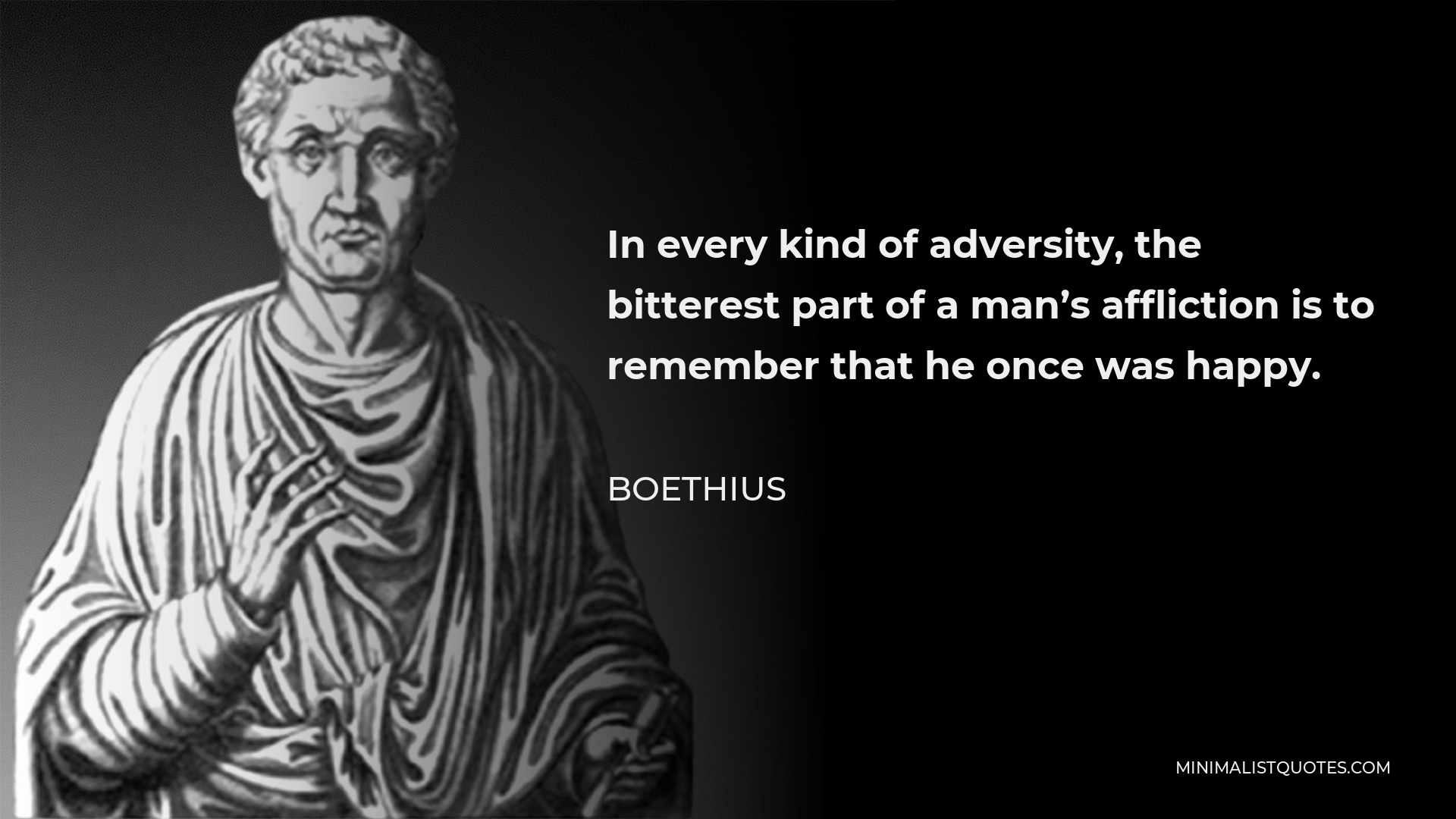
BOETHIUSIn every kind of adversity, the bitterest part of a man’s affliction is to remember that he once was happy.
More Boethius Quotes
-
-
Who would give a law to lovers? Love is unto itself a higher law.
BOETHIUS -
You know when you have found your prince because you not only have a smile on your face but in your heart as well. Love puts the fun in together, the sad in apart, and the joy in a heart. Who would give a law to lovers? Love is unto itself a higher law.
BOETHIUS -
For in all adversity of fortune the worst sort of misery is to have been happy.
BOETHIUS -
The science of numbers ought to be preferred as an acquisition before all others, because of its necessity and because of the great secrets and other mysteries which there are in the properties of numbers. All sciences partake of it, and it has need of none.
BOETHIUS -
In every adversity of fortune, to have been happy is the most unhappy kind of misfortune.
BOETHIUS -
The completely simultaneous and perfect possession of unlimited life at a single moment.
BOETHIUS -
Music is part of us, and either ennobles or degrades our behavior.
BOETHIUS -
Good men seek it by the natural means of the virtues; evil men, however, try to achieve the same goal by a variety of concupiscences, and that is surely an unnatural way of seeking the good. Don’t you agree?
BOETHIUS -
Music is so naturally united with us that we cannot be free from it – even if we so desired.
BOETHIUS -
A person is an individual substance of a rational nature.
BOETHIUS -
Nothing is miserable unless you think it so.
BOETHIUS -
If there is anything good about nobility it is that it enforces the necessity of avoiding degeneracy.
BOETHIUS -
As far as possible, join faith to reason.
BOETHIUS -
In every kind of adversity, the bitterest part of a man’s affliction is to remember that he once was happy.
BOETHIUS -
Nothing is miserable unless you think it so; and on the other hand, nothing brings happiness unless you are content with it.
BOETHIUS